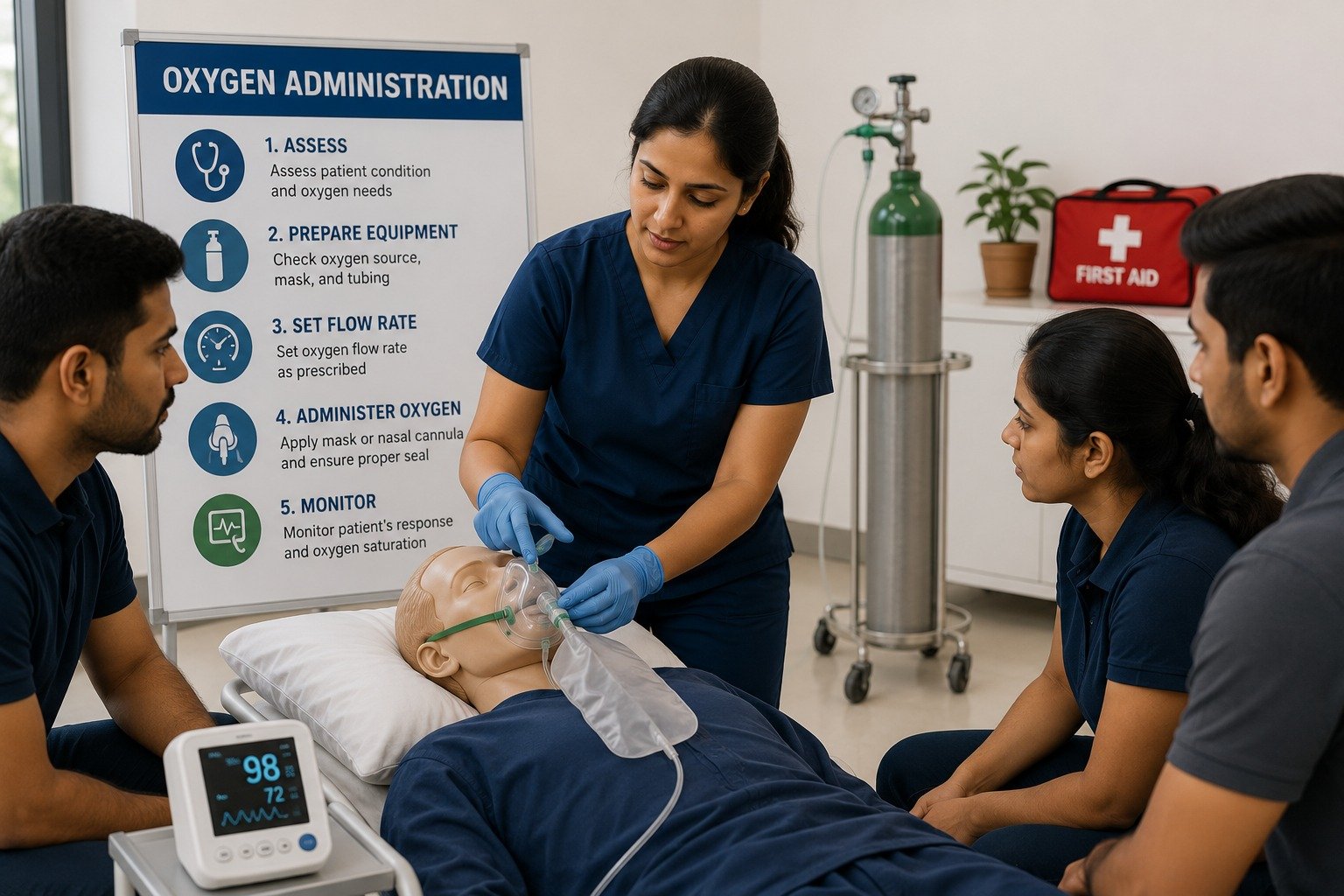
Learn the safe use and administration of emergency oxygen during medical and aquatic emergencies.
This course develops the knowledge and practical skills required to handle oxygen equipment safely, assess a patient, select an appropriate delivery device and administer emergency oxygen correctly.
Participants learn oxygen safety, cylinder and regulator setup, delivery-device selection, patient assessment, flow-rate control and practical administration during medical and aquatic emergencies.
Understand fire risk, storage requirements, handling precautions and safe operating procedures.
Inspect, assemble and test cylinders, regulators, tubing and delivery devices before use.
Assess breathing, skin colour, responsiveness and signs that may indicate oxygen support is needed.
Select the delivery method, set an appropriate flow rate and monitor the patient continuously.
By completing the program, participants will be able to prepare oxygen equipment, assess patients and administer emergency oxygen safely.
Inspect, assemble and operate oxygen cylinders, regulators and tubing using correct safety procedures.
Choose an appropriate oxygen mask or delivery method based on the patient’s condition.
Set the correct flow rate, apply oxygen safely and continuously reassess the patient.
The curriculum combines oxygen safety, equipment preparation, delivery-device selection, patient assessment and practical administration.
Understand fire hazards, cylinder storage, safe handling, contamination risks and operating precautions.
Identify cylinders, regulators, flowmeters, tubing, seals and essential emergency oxygen components.
Understand nasal cannulas, simple masks, non-rebreather masks and other oxygen-delivery options.
Assess responsiveness, breathing, skin colour, oxygen need and signs of respiratory distress.
Assemble equipment, select a device, set the flow rate, administer oxygen and monitor the patient.
Participants learn through instructor demonstrations, equipment setup practice, delivery-device selection and guided administration scenarios.
Clear demonstrations of cylinder safety, regulator setup and device connection.
Supervised equipment practice that improves safety, accuracy and confidence.
Realistic scenarios that test patient assessment, device selection and oxygen delivery.
Practice continuous observation, reassessment and safe handover to professional responders.
Join the Patient Assessment Programs program or contact us for customized rescue and safety training for schools, clubs, institutions, workplaces and community groups.